

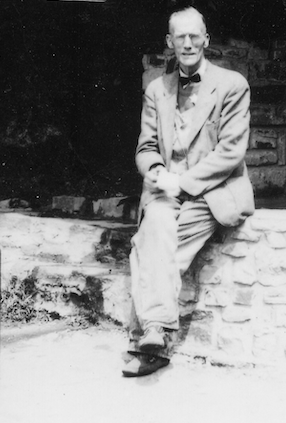
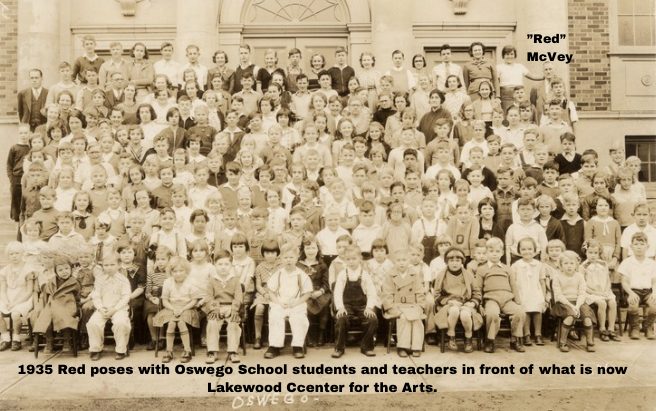
Nicknamed “Red” because of his flaming red hair, Arthur McVey was a jack of many trades: Oswego volunteer firefighter–his first love– and secretary of the firefighter group; custodian at Oswego School-children his second love–citizen advocate and preservationist; power plant construction worker; and truant officer.
McVey, his bright red hair flying in the wind, often strolled about town, handing out candy to the children he passed. He always had candy in his pockets for the kids. When he wasn’t fighting fires, Red worked as a janitor at Oswego School and served as a truant officer. If kids didn’t come to school, he would go their homes to find out why. One young lad who missed a lot of school for two years, Red discovered, was because the child suffered a lingering illness and wasn’t skipping school. Eventually, the youngster became well enough to attend school regularly.
A meeting of Oswego citizens in 1910 at Koehler’s Blacksmith Shop organized a-bucket-and-ladder brigade of volunteer fireman, consisting of George Miller, first chief, Edgar Davidson, William Cook, George Prosser, “Red” Mcvey. and Earl Hughes. These original “first five” manned equipment, such as it was. that consisted of twelve leather buckets, two axes and two 24-foot wooden ladders, one of which hung on the side of the Odd Fellows building in old town across from Lakewood School (then Oswego School) for years. The rest of the equipment hung out in the open on poles at Second and A Street and was pulled into service when Red sounded the fire alarm, a large bell that stood in front of his house in old town across from Lakewood School. When they heard that clang…clang…clang the men jumped into action.
Lake Oswego’s first piece of firefighting equipment–a self-contained Studebaker sedan, which the firefighters converted it into a truck for $555. They bought the prohibition-confiscated, unclaimed vehicle from the city for one dollar. McVey managed to raise $1,000 at the annual Fireman’s Ball to purchase a Ford panel truck, which was later traded in for a Cadillac ambulance.
At a City Council meeting on Feb. 8, 1952, then-Mayor Charles Needham declared an official change in street names to honor McVey. The road known as “Old Country Road,” led from Oak Street (in what was then known as New Town) west over the bridge past the dam to State Street, became McVey Avenue. Arthur Red McVey’s involvement with the firefighters continued until death in 1960. He was 83.
More about the lives and accomplishments of Edward Eastham, Parker F. Morey and the founding of the Glenmorrie area of Lake Oswego can be found in my book History Soup – stories of Oswego’s past available on Amazon : https://tinyurl.com/2kw55pz3 or directly from History Soup Press histsoup.press@gmail.com

We’re thrilled to welcome Nancy as a contributor to the Palisades Neighborhood Association’s monthly newsletter, where she’ll be serving up fascinating historical stories about Lake Oswego. Get ready to dive into the rich, colorful past of our community—History Soup style! Find out more about Nancy on her website, or purchase her books available on Amazon.
Nancy Dunis is a passionate public historian, dynamic storyteller, and published author with a flair for bringing the past to life. As the founder of History Soup Press, she’s the creative force behind the History Soup book series and The HistoriConnection blog. For over 20 years, Nancy has been sharing captivating historical nonfiction through newspaper columns, blogs, magazines, social media, newsletters, and three compelling books.
With a special focus on barrier-breaking women, infamous men, and unforgettable events, she uses a wide range of audience engagement techniques to make history accessible, exciting, and relevant.