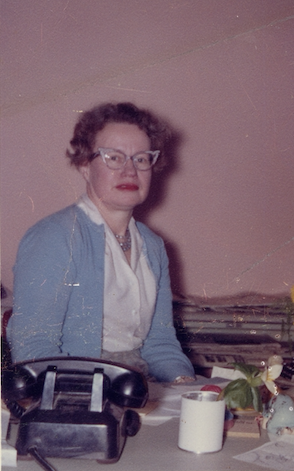
And was known for her horn-rimmed, winged glasses studded with rhinestones. “I was very fond of those glasses,” Lake Oswego Library volunteer Pat Snider used to tell people. “They were so distinctive and distinguishing.”
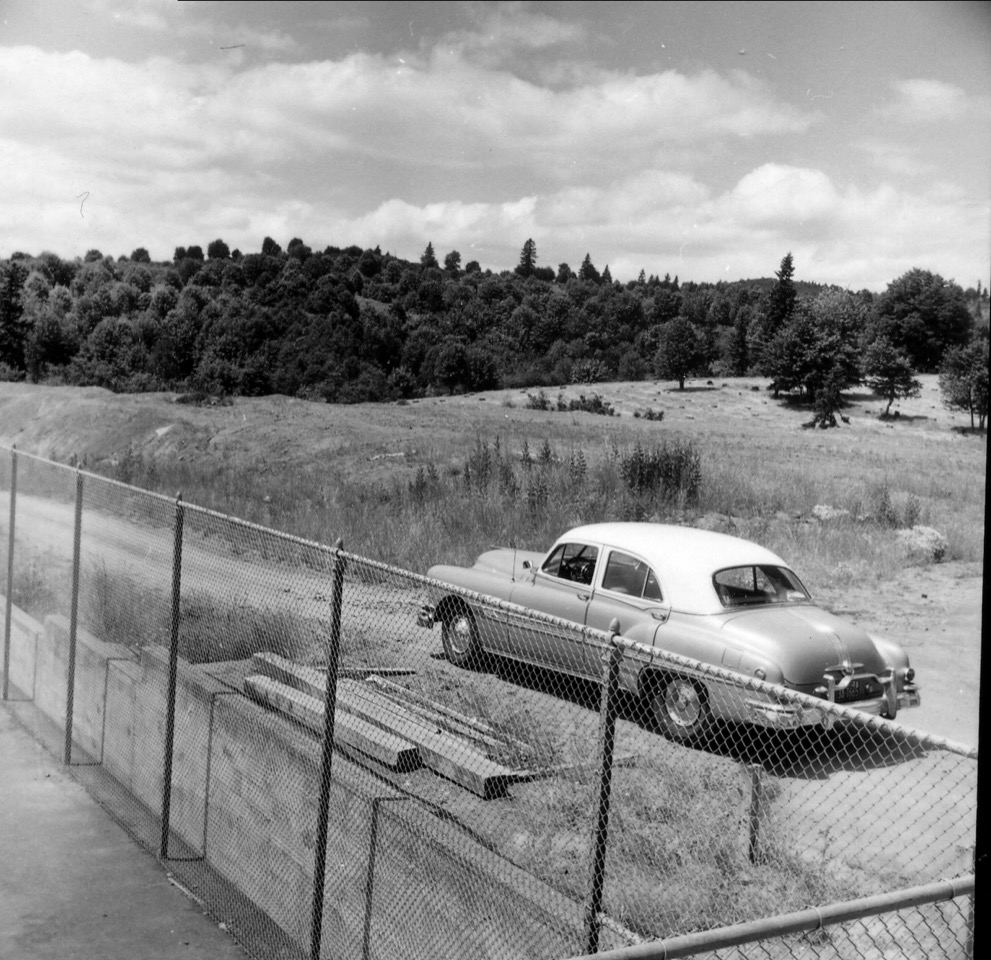
Elizabeth Salway Ryan (1910–1995), affectionately referred to as Beth, left Lake Oswego with a legacy greater than her glasses. For 22 years (1946 until 1968) the Oswego resident served as the Lake Oswego Review’s news editor, photographing and writing about everything from the annual Lions Club Pancake Breakfast fundraiser held annually on the 4 the of July in George Rogers Park to the plot of land sighted at Lake Oswego
High School for construction of a district swimming pool. Ryan took the photo in 1965; the pool was built in 1976.
“Beth Ryan appeared everywhere,” wrote reporter Cliff Newell in a 2010 Lake Oswego Review article: “auto accidents, the Festival of the Arts, parades, sporting events. When Don Schollander arrived back in LO after winning a gold medal at the 1964 summer Olympics, Ryan could hardly wait to get his story and a photograph. When a new business opened in town, Ryan was there; she even photographed and interviewed royalty–the
queens and courts of Rosaria who represented Portland-area high schools during Rose Festival.
Although her legacy to the community is considerable, Ryan’s most prestigious accomplishments came in 1953, 1970 and 71. She won three first place awards in 1953 from the Oregon Presswomen: best news story in a weekly paper; best feature story in a magazine, and best column in a weekly. She became the runner-up for the Woman of Achievement Award given by the National Federation of Press Women in 1970. The following year (1971) Ryan received the Off-Beat Award from The Portland Professional Chapter of Theta Sigma (now Women in Communication).
In addition to writing for the Lake Oswego Review, Ryan taught a family history writing class at Clackamas Community College. The stories the students wrote for the class inspired the publication of a book–¬Leaves from Family Trees –edited and compiled by Ryan with a forward by local author Alfred Powers. Powers (1887-1983) was a well-known author, journalist, teacher, book collector, historian, and book binder.
Intrigued that Ryan had taught a family history class that published a book in 1978, I wondered if LOPL had a copy. No, but they were able to find one. When I received the book, an attached note warned ‘ this book is fragile. Handle with care’. Perusing the book, I observed that the pages were stitched together with heavy thread–probably by hand–then glued to the cover. I wondered: “did Alfred Powers bind this book for Beth Ryan?”
Ryan left The Review in 1968 to become the editor of The China Post in Taipei, China. Her last Review column published October 10, 1968. She wrote “Taiwan is beautiful so I’m hoping some of you will come see it—and me. Two years from now I hope to return to my now cleaned off desk at the Review. Aloha.” The legendary award-winning writer passed away at age 85.
Born in 1910, Elizabeth Salway graduated from Franklin High School in 1923 and from the University of Oregon in 1931 with a journalism degree. She married Cornelius Ryan in 1932 whom she later divorced. After the divorce, she moved in 1938 with her father and three young children to Sunny Hill Farm located near Oswego Pioneer Cemetery. Ryan’s granddaughter and her husband live on the historic property.
NOTE: Nancy Dunis will be presenting Beth Ryan’s story Wed January 7th at the Tualatin Heritage Center 8700 SW Sweek Dr Tualatin 1:00-2:00PM FREE.
Sources: Lake Oswego Review, Oswego Heritage Council archives, Lake Oswego Public Library newspaper clippings. Photos: Beth Ryan Photo Collection at Lake Oswego Public Library
Learn more about Beth Ryan and Lake Oswego history in my book History Soup – stories of Oswego’s Past
Available on Amazon https://tinyurl.com/2kw55pz3 and at Lake Oswego Ace Hardware. Connect with Nancy: nancydunis.com or histsoup.press@gmail.com.

We’re thrilled to welcome Nancy as a contributor to the Palisades Neighborhood Association’s monthly newsletter, where she’ll be serving up fascinating historical stories about Lake Oswego. Get ready to dive into the rich, colorful past of our community—History Soup style! Find out more about Nancy on her website, or purchase her books available on Amazon.
Nancy Dunis is a passionate public historian, dynamic storyteller, and published author with a flair for bringing the past to life. As the founder of History Soup Press, she’s the creative force behind the History Soup book series and The HistoriConnection blog. For over 20 years, Nancy has been sharing captivating historical nonfiction through newspaper columns, blogs, magazines, social media, newsletters, and three compelling books.
With a special focus on barrier-breaking women, infamous men, and unforgettable events, she uses a wide range of audience engagement techniques to make history accessible, exciting, and relevant.