Ann Wade Parshall Schukart (1906-1995) lost two husbands before their time. Her high school sweetheart and first husband Robert Parshall (1906 -1959), died suddenly from insulin shock at the peak of his career as a real estate developer in Oswego, OR.
Having an interest in business, Ann Parshall was determined to keep her husband’s venture going. Prior to his unexpected death, Parshall bought the holdings of Paul F. Murphy, son of well-known Oswego developer Paul C. Murphy, His passing meant Ann now owned half of Oregon Iron and Steel Company real estate, which encompassed a great deal of prime property around the lake suitable for housing developments.
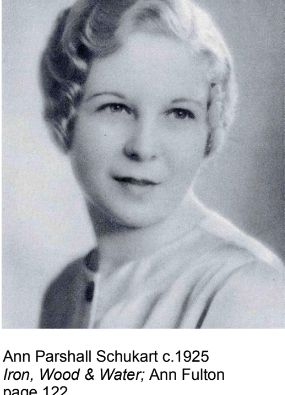
Unsure what to do with this sudden acquisition of landholdings, Ann sought a recommendation from her local banker of someone who could advise her. The bank suggested Adam Schukart. “I really liked him. We worked together; ate together; and were together all the time except we went to different homes at night..” Schukart recalled. Adam George Schukart and Ann Wade Parshall married in 1960.
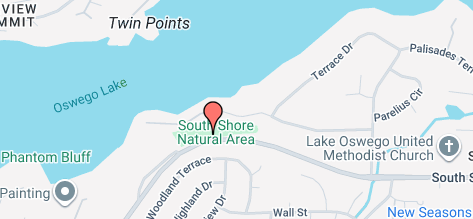
But four years later (1964) tragedy struck again: Adam died of a brain aneurism. Not to be stopped by such untimely misfortunes, Ann became very active in the Lake Oswego community: charter member of the Oswego Lake Country Club, member and secretary of the Chamber of Congress, director and secretary of the Lake Oswego corporation, member of a Oswego Garden Club, member of the Republican Women’s Club, an advisor to the Adult Community Center. She also contributed significant funds to the purchase and renovation of Lakewood Center for the Arts; but her crowning achievement: the preservation of 7.3 acres of the Wade family lakefront estate now known as the South Shore Natural Area.
When her parents Robert and Lura Wade died, Ann inherited the property and quickly established a trust, making her younger sister Roberta (Bobbie) Wade Pierce Kent a major benefactor. Bobbie acted on behalf of the trust to ensure her sister’s dream of preserving part of the family estate as a natural area would be realized and maintained. Ann’s dream became a reality in 1996 when the trust sold 7.3 acres of the estate to the City of Lake Oswego. Sale of the Wade property was significant because it stipulated the area had to remain au naturel, meaning it could not be developed for residential or commercial use.
Today the South Shore Natural Area hosts a sanctuary for wildlife viewing and serene outdoor recreation rather than active sports or playground facilities. The area is a popular place for leisurely strolls and running as it features well-maintained, soft-surface trails, portions of which offer views of the water and surrounding landscape.
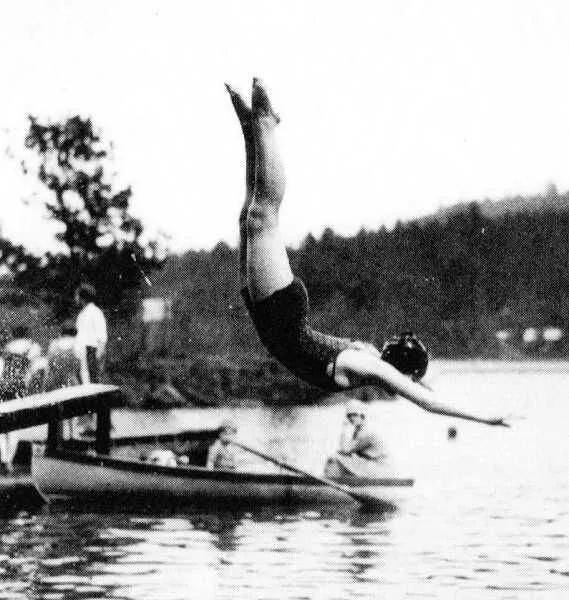
In addition to her philanthropic legacy of land, Ann Schukart, seen diving off the Jantzen Island bridge, became the inspiration for Jantzen Swimwear’s ‘Red Diving Girl” logo. Carl Jantzen, founder of Jantzen Knitting Mills thought the lake was a perfect backdrop for promoting swimwear and often invited distributors, customers, and the like to the island-located on the north side of the lake at the end of North Shore Road–for a day of swimming, dining, boating and buying. Carl and Emma Jantzen purchased the island home in 1929 for $50,000.
Sources:
Iron Wood and Water by Ann Fulton
LO Review Article by Nancy Dunis 10/19/2017
For more stories about Lake Oswego’s history, copies of my book History Soup -Stories of Oswego’s can be purchased on Amazon https://tinyurl.com/2kw55pz3 and at Lake Oswego Ace Hardware. Connect with Nancy: nancydunis.com or histsoup.press@gmail.com.

We’re thrilled to welcome Nancy as a contributor to the Palisades Neighborhood Association’s monthly newsletter, where she’ll be serving up fascinating historical stories about Lake Oswego. Get ready to dive into the rich, colorful past of our community—History Soup style! Find out more about Nancy on her website, or purchase her books available on Amazon.
Nancy Dunis is a passionate public historian, dynamic storyteller, and published author with a flair for bringing the past to life. As the founder of History Soup Press, she’s the creative force behind the History Soup book series and The HistoriConnection blog. For over 20 years, Nancy has been sharing captivating historical nonfiction through newspaper columns, blogs, magazines, social media, newsletters, and three compelling books.
With a special focus on barrier-breaking women, infamous men, and unforgettable events, she uses a wide range of audience engagement techniques to make history accessible, exciting, and relevant.