

But anxiety taking tests got the better of him. Nathan Farragut Twining, one of America’s highest ranking military officers, failed the US Naval Academy entrance exam. Despite failing the exam, Twining enjoyed a stellar, life-time military career, beginning with his enlistment in the Oregon National Guard at sixteen.
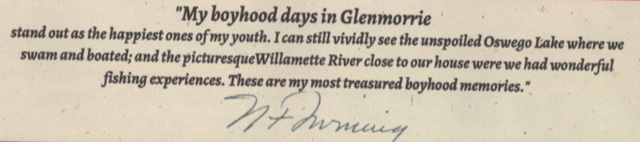
The Twining family moved from Monroe, Wisconsin to Oregon in 1913. Banking opportunities along with hunting and fishing motivated Clarence Twining and his first wife Maize Barbur Twining to relocate the family to the ‘Great Northwest, settling first in Portland than moving to the Glenmorrie area of Oswego.
Nathan Twining joined the Oregon National Guard Company H of the Third Oregon Infantry in 1915 while attending Lincoln High School in Portland. He claimed, “I joined the Oregon National Guard because they had a great rifle range and I like to shoot as evidenced by my love of hunting.”
Serving as a corporal during the Mexican border crises for The Guard, Twining then received an appointment to West Point in May of 1917, through the Oregon National Guard, after placing well on a competitive exam specifically for Oregon National Guard members.
Graduating from West Point as a second lieutenant of Infantry, he remained assigned to the Academy as an officer cadet for three years then reassigned to the Air Service where he flew fighter planes for 15 years. At the same time he was in the Air Service, Twining also attended the Air Corps Tactical School and the Command and General Staff College.
General Twining served in the U.S. military for almost 44 years. His career included service in the Army infantry, Army Air Corps, and the US Air Force, where he became Chairman of the Joint Chiefs of Staff, appointed by President Eisenhower. He served from 1957 – 1960. Other major appointments held by General Twining: Commander of the 13th, 15th, and 20th Air Forces during WWII and Chief of Staff of the Air Force (1953–1957) before becoming Chairman of the Joint Chiefs. He ended his illustrious military career as the FIRST Air Force officer to serve in this capacity.
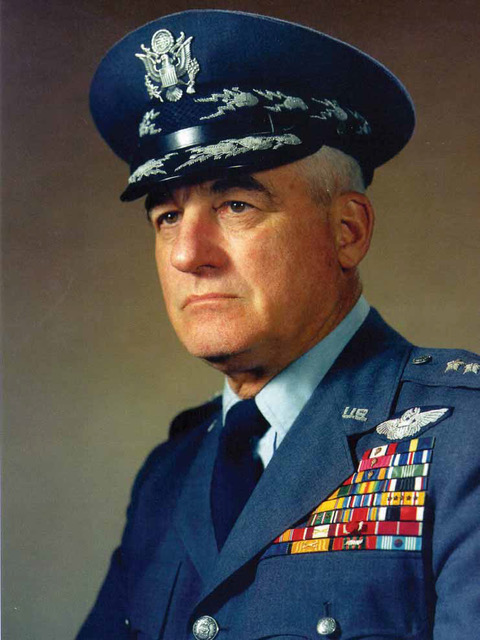
Eisenhower re-appointed General Twining Chairman of the Joint Chiefs of Staff for a second term in 1959. However, he chose to take early retirement September 30, 1960 due to deteriorating health following major surgery, During his military career Nathan Farragut Twining received 32 distinct honors, awards, and medals of distinction.
Following his retirement from active duty Twining worked as vice chairman for the publishing firm Holt, Rinehart and Winston. Twining received the General William E. Mitchell Memorial Award in 1965.
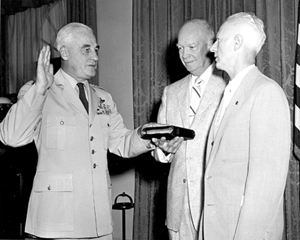
A career Air Force officer who catapulted from private to four- star general, General Twining came from a lineage of military men: Grandfather – Nathan Crook Twining was a Civil War captain; Uncle – Nathan Crook Twining was a Rear Admiral naval officer who served as Chief of Staff to Admiral William Sims during WWI; Brothers: Merrill B. Twining – A US Marine Corps four-star General; Robert B. Twining – A Captain in the US Navy; Edward Twining – Served in the Air Corps and intelligence during WWII, Eldest son – Major Richard G. Twining served in the U.S. Air Force. retiring with the rank of Major; daughter Olivia married a military man – Colonel Haywood Shepherd “Tony” Hansell !!!, son of Major General Haywood, Jr., a bombing strategist during WW!!.
Born in 1897, Nathan Farragut Twining died March 28, 1982 at age 85 at Lackland Air Force. He and his wife are buried at Arlington National Cemetery. The Twining home in Glenmorrie still stands and is listed on the National Historic Register.
Sources: Nationalaviation.org, Mediadefense.org Findagrave.com, “In their Own Words” by Theresa Truchot, “Oregon’s Iron Dream” by Mary Goodall, militaryhallofhonor.com
Learn more General Nathan Farragut Twining and Lake Oswego history in my book History Soup – stories of Oswego’s Past available on Amazon https://tinyurl.com/2kw55pz3 and at Lake Oswego Ace Hardware. Connect with Nancy: nancydunis.com or histsoup.press@gmail.com.

We’re thrilled to welcome Nancy as a contributor to the Palisades Neighborhood Association’s monthly newsletter, where she’ll be serving up fascinating historical stories about Lake Oswego. Get ready to dive into the rich, colorful past of our community—History Soup style! Find out more about Nancy on her website, or purchase her books available on Amazon.
Nancy Dunis is a passionate public historian, dynamic storyteller, and published author with a flair for bringing the past to life. As the founder of History Soup Press, she’s the creative force behind the History Soup book series and The HistoriConnection blog. For over 20 years, Nancy has been sharing captivating historical nonfiction through newspaper columns, blogs, magazines, social media, newsletters, and three compelling books.
With a special focus on barrier-breaking women, infamous men, and unforgettable events, she uses a wide range of audience engagement techniques to make history accessible, exciting, and relevant.