

“I thought I would split in half,” chortled fourteen-year old Willa Worthington after her first water ski lesson with dad Wally. “I knew pigs and chickens and horses, and I knew water–I was training to become an AAU diver– but water skiing? Once I got the hang of it I knew it was MY SPORT,” the Lake Oswego teenager continued.
Willa entered her first water ski competition at sixteen in 1946. Even though she had never seen a slalom course before, Willa pulled off a first place win. Earning 18 national titles and four world titles during her tournament career. Worthington was Inducted into the inaugural USA Water Ski & Wake Sports Foundation Hall of Fame in 1982 and the International Water Ski & Wakeboard Federation (IWWF) Hall of Fame in 1989.
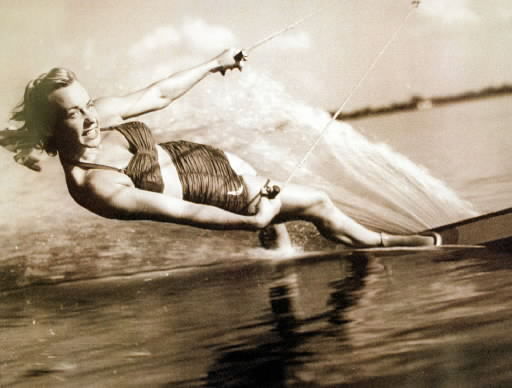
A champion for sure, but her forte was creativity, not only with her stylized ballet moves pn skis but in the water as well. Worthington introduced water ballet –synchronized swimming–to Lake Oswego and was the first to use music as an accompaniment to water ski show skiing and water ballet. Willa’s creativity didn’t end there; she also designed and made all the costumes–mostly out of shower curtains–for the first Lake Oswego Water Ski Festival held in September 1955 on the Willamette River at George Rogers Park.
Impressed with her waterskiing ability, blond blue-eyed good looks, and ballet moves Dick Pope, Sr., founder of Cypress Gardens Theme Park in Florida, recruited Worthington to perform as prima ballerina with his Aquamaids water ski show team.
Willa starred as the main attraction for ten years; she played the role of Esther Williams in two movies; was the first to master the backward swan on skis and the first to ski backwards over a jump. Ralph Samuelson, inventor of water skiing, tried it. SPLAT…he didn’t quite make it.
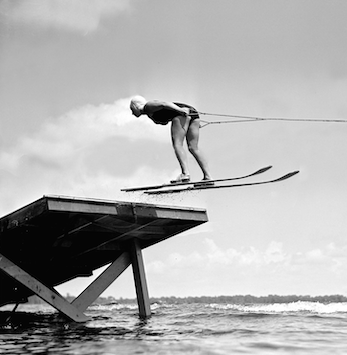
Even though a woman mastered the backward jump before a man, the macho males of Cypress Gardens thought “I still wasn’t good enough to be part of the jump act. Go out and learn something new then you can be in the act,” they told her. Not one to be dissuaded, Willa mounted a pair of bindings similar to the old snow ski bindings, backward on a pair of water skis. Her second pass she flew smoothly over the jump; landed ; skied off and never looked back. From that point on Willa had a spot with the macho men on the jump team. And she always looked back when appropriate.
Trick innovations came naturally for Willa. She used the swivel swan in her winning tricks routine at the 1950 world tournament, but it was disqualified as a “gadget not readily available to all.” However, her swivel ski did become standard equipment for water ski shows.
“In an era when not many women were athletes, Willa Worthington McGuire Cook was far and beyond the most talented.,” University of South Florida American Studies Professor
Robert Snyder commented about Willa’s athleticism. The Grand dame of water skiing, known as the ‘first of the best’, passed away at age 89 in 2017.
Travelling down McVey Ave toward George Rogers Park, the Worthington family home is on the right about half way down at the corner of Bickner Street and McVey, white with an upper veranda. The home is listed on the National Historic Register and is a designated Lake Oswego historic landmark.
Sources
History Soup – stories of Oswego’s past by Nancy Dunis
Water Ski Magazine 75th anniversary edition
USAwaterski.org
History of Water Skiing on Lake Oswego by Marylou Colver May 2016
Photo credits: Lake Oswego Public Library, Watersports USA
For more stories about Lake Oswego’s history, copies of my book History Soup -Stories of Oswego’s can be purchased on Amazon https://tinyurl.com/2kw55pz3 and at Lake Oswego Ace Hardware. Connect with Nancy: nancydunis.com or histsoup.press@gmail.com.

We’re thrilled to welcome Nancy as a contributor to the Palisades Neighborhood Association’s monthly newsletter, where she’ll be serving up fascinating historical stories about Lake Oswego. Get ready to dive into the rich, colorful past of our community—History Soup style! Find out more about Nancy on her website, or purchase her books available on Amazon.
Nancy Dunis is a passionate public historian, dynamic storyteller, and published author with a flair for bringing the past to life. As the founder of History Soup Press, she’s the creative force behind the History Soup book series and The HistoriConnection blog. For over 20 years, Nancy has been sharing captivating historical nonfiction through newspaper columns, blogs, magazines, social media, newsletters, and three compelling books.
With a special focus on barrier-breaking women, infamous men, and unforgettable events, she uses a wide range of audience engagement techniques to make history accessible, exciting, and relevant.