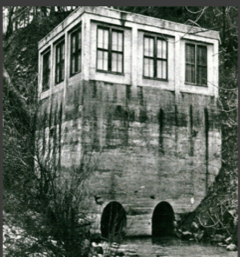
You can’t quite see it and you can’t hear it; but a massive Westinghouse water turbine patented in 1905 has been generating electricity here for 118 years. The manufacturer design plate reads ‘2400 volt, 360 RPM 700 horsepower generator with a 48-inch Francis, double-cupped water wheel mounted on a 7-inch continuous shaft. If you stopped traffic on the McVey Bridge and peered over the railing to the south, you would see Oswego Hydro, the building that houses ye olde Westinghouse.
Built in 1909 by Oregon Iron and Steel (OIS), Oswego Hydro was the brainchild of OIS shareholders as a means to several ends: generate electricity for their iron pipe and foundry business; resell the electricity to improve cash flow; and maintain their water rights. OIS owned the Oswego Creek Dam and Oswego water rights; but in order to retain those rights, the water had to be used for industrial purposes. With the cessation of iron production in 1894 and commerce almost at a standstill, those rights were in jeopardy of being lost.
OIS hired electrical expert Nathanial S. Keith to investigate the feasibility of building a power plant here. Keith green-lighted the town for a power plant, which became known as Oswego Hydro. Referred to now as the Power Plant, the Lake Oswego Corporation took over ownership and maintenance of it in 1960.
Although ye olde Westinghouse produces electricity to this day, it is not without hiccups. When it goes offline, only qualified personnel with specialized skills were allowed to work on it. During the 1950’s and 60’s, a handful of people could be called upon; but as of 2015, only one person of that select group was still around: the Lake Corporation’s head of maintenance Stuart Dunis (author’s brother). Dunis, the youngest member of this elite repair team. spent hundreds of long hours during his sixteen-year career at LOC working on the turbine. Dunis remembers one year making a specialized part by hand in his garage while awaiting the arrival of the one he ordered from Westinghouse just so the power plant could get back on line and electricity restored quickly.
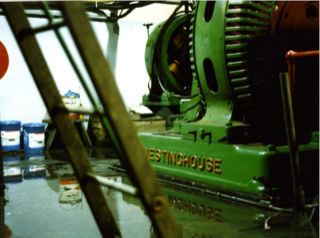
Dunis also shared that “starting about 1925, full-time operators were needed to physically man the turbine from 6:00 am to 10:00 pm seven days a week. After 1955 twice daily checks replaced the 24/7 turbine watch. Many men filled the role of turbine operators, Some names you might recognize: Cecil Trainer, Rocky DeBellis 1955 – 1964 (Trainer and DeBellis also served as Lake Wardens in the early days.) Chuck Schaeffer (Schaeffer also served as Lake Warden / Lake Manager.), Stuart Dunis 1987 – 2003. Others who made it possible for Oswego Hydro’s Westinghouse generator to keep on turning include Carl Halvorson (developer of Mtn. Park), M. McCarty (machinist), L. Fisher (BPA engineer), S. Henderson (inventor), and Bill Banks (electrician).
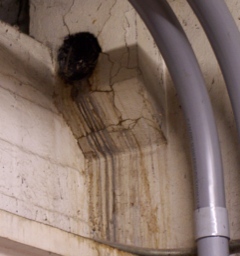
Banks recalled in an interview with Theresa Truchot,” One night, sitting in front of the pot-bellied stove with the doors wide open, a logging train had just gone by. Shortly afterwards I heard this groanin’ sound. It went on for hours. When daylight came, I said to my relief operator ‘It sounded like somebody’d been hit by that logging train from all the groaning that was going on.’ “Oh, those are just bull frogs out in the swamp.” You can see the spot in the wall where the pipe from the stove carried the smoke to the outside. (See photo.)
Dunis commented, “ Oswego Hydro transmitted electricity to Old Town, South Town, New Town, Dunthorpe and then to somewhere in Portland. There’s a transmission map inside the power plant I used to study during my watch but it’s small and I couldn’t make out the Portland Part.
Sources: Lake Corporation archive document,
Dunis Interview – “In Their Own Words” by Theresa Truchot
Photos: author’s personal collections
Sources: History Soup – stories of Oswego’s past by Nancy Dunis
For more stories about Lake Oswego’s history, copies of my book History Soup -Stories of Oswego’s can be purchased on Amazon https://tinyurl.com/2kw55pz3 and at Lake Oswego Ace Hardware. Connect with Nancy: nancydunis.com or histsoup.press@gmail.com.

We’re thrilled to welcome Nancy as a contributor to the Palisades Neighborhood Association’s monthly newsletter, where she’ll be serving up fascinating historical stories about Lake Oswego. Get ready to dive into the rich, colorful past of our community—History Soup style! Find out more about Nancy on her website, or purchase her books available on Amazon.
Nancy Dunis is a passionate public historian, dynamic storyteller, and published author with a flair for bringing the past to life. As the founder of History Soup Press, she’s the creative force behind the History Soup book series and The HistoriConnection blog. For over 20 years, Nancy has been sharing captivating historical nonfiction through newspaper columns, blogs, magazines, social media, newsletters, and three compelling books.
With a special focus on barrier-breaking women, infamous men, and unforgettable events, she uses a wide range of audience engagement techniques to make history accessible, exciting, and relevant.