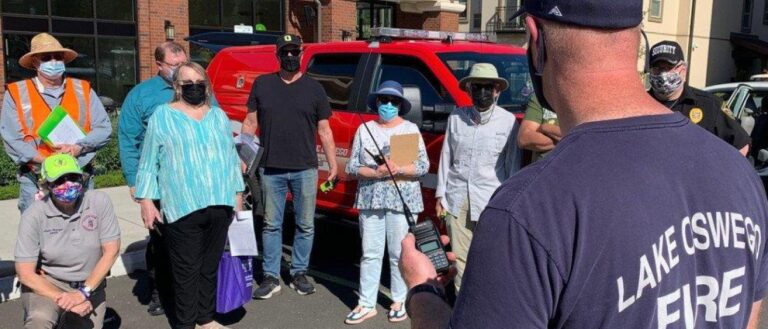
When a major storm, wildfire, earthquake, or extended power outage disrupts cell service and internet access, a simple two-way radio may be one of the most practical ways to stay connected with nearby neighbors.
Many Lake Oswego residents experienced this firsthand during the 2021 ice storm, when prolonged outages made phones, internet, and other usual communication methods unreliable. Two-way radios are inexpensive, easy to keep in an emergency kit, and can help neighbors share timely information, check on one another, and coordinate resources when normal communication is unavailable.
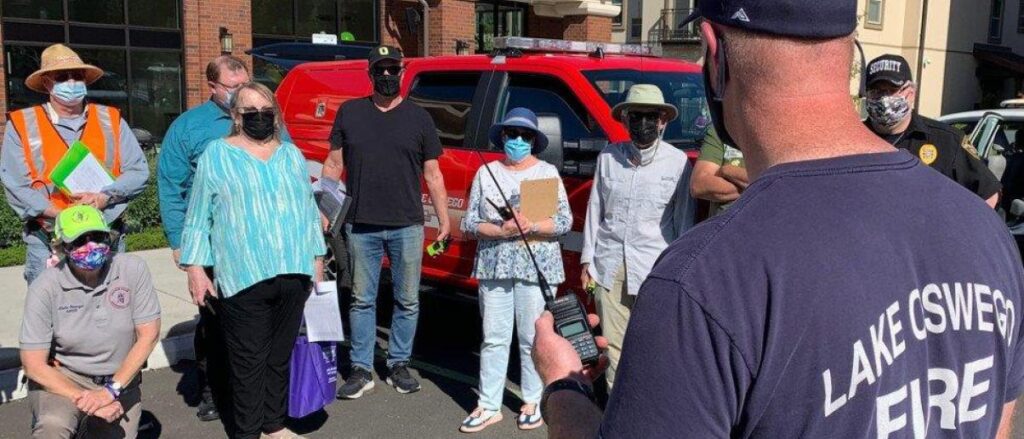
The City of Lake Oswego recommends maintaining at least a 72-hour emergency kit, while recognizing that households should aim to be self-sufficient for 7–14 days when possible. This includes water, food, medications, pet supplies, warmth, lighting, and reliable communication tools. [1]
Palisades Neighborhood Radio Plan
The Palisades Neighborhood Association is divided into East and West areas for local emergency radio communication.
| Palisades Area | Neighborhood Sections | Primary Radio Channel | Privacy Code |
|---|---|---|---|
| Palisades West | 2, 3, 10, 12, and 13 | Channel 4 | Code 14 |
| Palisades East | 1, 4, 5, 6, 7, 8, 9, and 11 | Channel 6 | Code 14 |
In an emergency, begin by monitoring and communicating on the assigned channel for your section of Palisades. Keeping radio use brief, clear, and purposeful helps ensure that everyone has an opportunity to communicate.
A useful format is:
“This is [first name] in Palisades [East/West], section [number]. I am at [general location]. I have [information/request].”
For example:
“This is Alex in Palisades West, section 10. I am near [street name]. Our household is safe. We have information about a downed tree blocking the road.”
Avoid sharing sensitive personal information over the radio. “Privacy codes” reduce unwanted audio from other users but do not make a conversation private or encrypted.
FRS and GMRS: What Is the Difference?
The two most common radio options for neighborhood use are Family Radio Service (FRS) and General Mobile Radio Service (GMRS). They share the same 22 primary channels, so FRS and GMRS radios can communicate directly with one another on those shared channels.
FRS Radios
FRS radios are generally the easiest option for most households.
- No FCC license is required.
- They are simple to operate and widely available.
- They use fixed, non-removable antennas.
- Typical neighborhood range is often about 1–2 miles, though hills, trees, buildings, weather, and terrain can substantially affect performance.
- They are well suited for communication within a neighborhood, especially when users are outdoors or have a relatively clear line of sight.
The City of Lake Oswego encourages households to keep at least one FRS radio in their emergency supplies. FRS radios cannot transmit through a GMRS repeater, but they can listen to repeater traffic. [1]
GMRS Radios
GMRS radios provide additional capability for residents who want greater range and access to the Lake Oswego GMRS repeater.
- An FCC GMRS license is required to transmit.
- No examination is required.
- A GMRS license is currently $35 and is valid for 10 years.
- The license covers the individual licensee and immediate family members.
- Handheld GMRS radios commonly transmit at up to 5 watts, depending on the channel and radio.
- Some GMRS radios can connect to an external antenna, which may significantly improve range when properly installed.
- GMRS radios can communicate on the shared FRS/GMRS channels and can access designated repeater channels.
GMRS performance is strongest when radios have a clear path between them. Hills, dense vegetation, homes, and other obstacles can reduce range. An elevated external antenna can make a substantial difference for a fixed home location, especially during a widespread emergency.
To obtain a GMRS license, create an account in the FCC’s Universal Licensing System (ULS), apply for a GMRS license, pay the fee, and receive an FCC-issued call sign. No test is required. Licensed users should identify with their assigned call sign as required during GMRS operation.
Lake Oswego Citywide GMRS Repeater
Lake Oswego has a citywide GMRS repeater intended for properly licensed GMRS users for casual, training, and emergency communications. The repeater can help connect people who cannot reach one another directly because of terrain or distance.
For Lake Oswego emergency communication:
- GMRS Repeater: Channel 17
- Privacy Code: 18
- GMRS Frequency: 462.600 MHz
- Repeater Offset: +5 MHz
- Tone: 123.0 Hz
FRS radios may listen to traffic on Channel 17 with privacy code 18, but they cannot transmit to the repeater. GMRS-capable radios may use the repeater only when operated by an appropriately licensed GMRS user. [1]
The City also offers a weekly GMRS repeater check-in opportunity on Monday evenings for GMRS license holders. Regular practice is one of the best ways to become comfortable with radio operation before an emergency occurs.
Radio Options for Palisades Households
There are many suitable FRS and GMRS radios. The best choice depends on whether a household wants simple neighborhood communication or added GMRS/repeater capability.
Motorola Talkabout T600 Series — FRS
The Motorola Talkabout T600 series is a practical FRS option for many households. These radios are weather-resistant, float in water, and include access to NOAA weather channels and weather alerts. They are easy to operate, do not require a license, and are well suited to local Palisades communication.
A two-radio package is commonly priced around $140, although pricing and availability vary. For households that want a straightforward, ready-to-use emergency radio, this is a strong option.
Radioddity GM-30 — GMRS
The Radioddity GM-30 is a compact, lower-cost GMRS handheld radio. It can communicate on the shared FRS/GMRS channels and, when programmed and used by a licensed GMRS operator, can access the Lake Oswego GMRS repeater.
This model is often a reasonable entry-level choice for residents who want GMRS functionality without purchasing a more expensive radio. Verify that the selected model is GMRS-capable and can be programmed for the Lake Oswego channel plan.
BTECH GMRS-V2 — GMRS
The BTECH GMRS-V2 is another GMRS option with a user-friendly design and programming support. It can be configured for Lake Oswego neighborhood channels and GMRS repeater use. It is often available through online retailers and is typically priced around $65, though prices vary.
For residents seeking a GMRS radio with more flexibility than a basic FRS unit, the GMRS-V2 is worth considering.
Getting Started
- Purchase and charge your radios.
- Label each radio with your household name, Palisades section, and assigned channel.
- Program or select your assigned local channel:
- Palisades West: Channel 4, privacy code 14
- Palisades East: Channel 6, privacy code 14
- Practice using the radio with household members and nearby neighbors.
- Keep radios with your emergency supplies, along with spare batteries or a charging plan.
- If using GMRS, obtain an FCC license before transmitting and learn how to access Channel 17 with privacy code 18.
- Monitor weather and emergency updates using NOAA weather channels when available.
Learn More and Practice Before an Emergency
The City of Lake Oswego Fire Department has prepared radio channel plans, quick-start materials, training resources, and a one-hour instructional video covering two-way radio use. These resources are especially helpful for residents who are new to FRS or GMRS radios.
Visit the City of Lake Oswego Emergency Communications page:
https://www.ci.oswego.or.us/fire/emergency-communications
The City’s materials also emphasize an important reminder: neighborhood FRS and GMRS radios are not a replacement for 911 and cannot communicate directly with police, fire, or other public-safety radio systems. They are a practical tool for neighbor-to-neighbor communication when conventional methods are unavailable. [1]
Preparedness works best when neighbors know one another, have a plan, and practice before an emergency. A radio in each household can be a simple but meaningful step toward a more connected and resilient Palisades community.
Sources:
- Emergency communications | City of lake oswego. ci.oswego.or.us